Grid Search
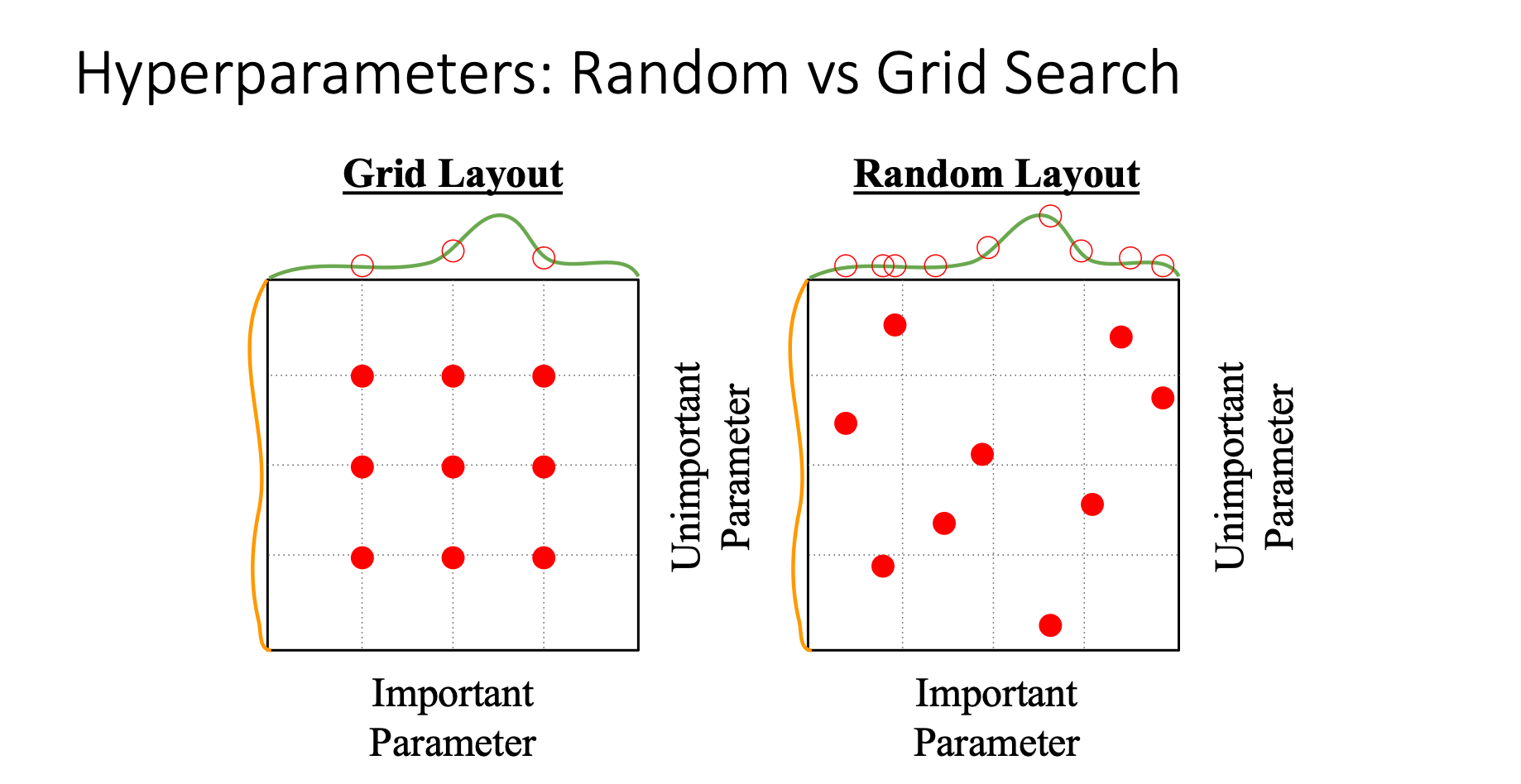
Strategy: Choose specific values for each hyperparameter (typically log-spaced), then test every possible combination.
Example: Learning rate = , Batch size = → Total combinations = 3 × 3 = 9 trials
Limitations:
- Exponential growth: values × parameters = combinations
- Limited exploration: Only values tested per parameter
- Inefficient: Many resources wasted on unimportant parameter combinations
Random Search
Strategy: Define ranges for each hyperparameter, then randomly sample values within those ranges for each trial.
Example: Learning rate , Batch size → Each trial samples random values from these ranges
Advantages:
- Better coverage: More diverse values tested per parameter
- Finds important parameters: Automatically focuses on parameters that actually matter
- Flexible: Can run as many trials as time/budget allows
Key Takeaway
Random search often outperforms grid search because it explores the hyperparameter space more effectively, especially when only a few parameters significantly impact performance.